grave-sounder
The InvincibleThe grave-sounder is an experimental neurological instrument used to recover the last surviving contents of a dead person’s consciousness. Its decisive importance lies in the contradiction it embodies: it offers the investigation of the Condor tragedy access to testimony that ordinary witnesses cannot provide, yet what it retrieves is so fragmentary and unstable that it cannot establish a trustworthy account of what happened. The device turns a corpse into an apparent witness while preserving the silence, ambiguity, and interpretive danger of death.
Definition and Construction
The grave-sounder is kept in a small black case and operated through reels of wire ending in flat electrodes. Dr. Sax attaches six electrodes to the frozen man’s skull, secures them with sticking tape, then puts on headphones and adjusts the apparatus’s controls with unusual composure. The instrument sends electrical impulses into the depths of the brain. These impulses follow pathways of least resistance, especially nerve fibers that had formed a functional whole immediately before death, and thereby produce traces of the consciousness that remained at the end of life.
The device is usable because the body has not begun to decompose. The low temperature in the hibernation chamber has preserved the dead man sufficiently for what the ship’s jargon calls “listening to the brain.” The procedure is not an attempt to revive him. Rohan realizes that Sax has come chiefly to discover what the brain might still reveal, even though the man’s frozen condition makes the experiment possible. In a situation where so much depends on explaining the Condor’s tragedy, the instrument is treated as necessary despite the warnings surrounding its reliability.
The Condor Experiment
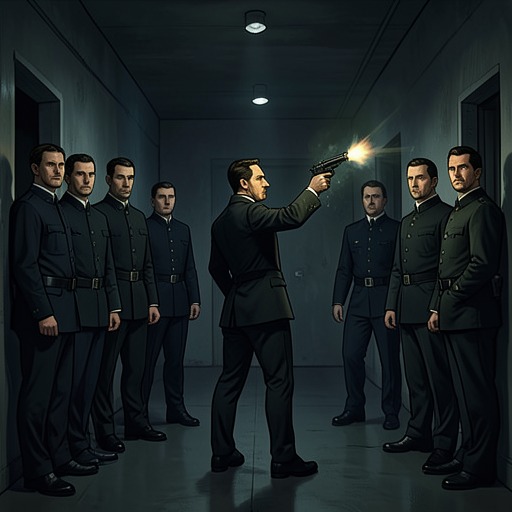
Sax first encounters only the electrical hum of the apparatus, while Rohan, wearing a second pair of headphones, initially hopes that the unknown man’s brain will remain mute. The grave-sounder then generates a gray, ash-like image suspended at an indistinct distance. Rohan perceives what seems to be a passageway inside the ship, with pipes overhead and human bodies blocking it from side to side. The figures appear to move, but the movement is later identified as an illusion produced by the unstable recording rather than evidence that the people were alive at the moment represented.
The image is physically indistinct and repeatedly changes shape. The bodies are half naked, their remaining clothing hanging in tatters; their unnaturally white skin appears covered with black marks, while similar comma-shaped spots seem to cover the floor and walls. The whole scene trembles and undulates like a blurred photograph viewed through running water. When Rohan opens his eyes, the image darkens almost to disappearance, but Sax’s further adjustments bring a faint vocal trace into the headphones: “Ala . . . ama . . . lala . . . ala ma . . . mama . . .” The amplifier then oscillates violently, producing a squeaking sound that resembles terrible laughter before the electrical interference overwhelms the result.
The recovered material does not amount to a coherent message. Sax explains that the repetition occurs because he is scanning the entire parietal cortex, the region associated here with auditory memory. The extraordinary discovery is not that a dying man might think of his mother, nor that the syllable “mama” can be heard, but that the auditory memory itself is almost entirely empty. Ordinarily, a scan of the parietal lobe would contain so many recorded words that the result would resemble an attempt to read a hundred books at once. This brain contains no such accumulation: apart from the few syllables, there are no words.
Evidence and Uncertainty
The grave-sounder’s findings generate a barrage of questions but no conclusion. The image of the bodies and the dark markings becomes a possible clue to the Condor crew’s fate, yet Sax insists that the recording is not a moving scene in the ordinary sense. Engrams are recorded like a photograph, and a composite of several images can sometimes occur, although he does not believe that happened in this instance. When Rohan asks whether the marks might also be an illusion, Sax cannot exclude the possibility, though he does not think they were.
The doctors also stress that necroptic soundings are never conclusive. The commander recognizes that the procedure might lead the investigators up the garden path, sending them toward an attractive but false explanation. Nevertheless, he allows the result to be examined because, at that moment, no further harm seems likely to come from pursuing it. The grave-sounder therefore functions less as a machine for recovering truth than as an apparatus for multiplying hypotheses: the same fragment can suggest violence, disease, insects, panic, or an entirely different process that the investigators do not yet understand.
Gaarb proposes that the black spots resemble the “flies” and wonders whether poisonous insects killed the crew. Under this theory, the frozen man might have escaped the insects, fled from the fate of his companions, and then died from the cold. But that explanation immediately encounters another unresolved fact: the man had suffered a profound loss of memory before his death. The grave-sounder cannot explain that condition; it only reveals that even his auditory memory has been emptied of nearly all language.
Relation to Memory and Personality
The instrument’s most unsettling revelation is consequently negative. It does not uncover a hidden confession or a complete final perception. Instead, it exposes an absence where a human history should be. The dead man’s brain retains only a few repeated syllables, while the verbal structures through which identity, experience, and communication might be reconstructed have vanished. The grave-sounder makes memory visible as both physical trace and catastrophic erasure.
This absence connects the experiment with the later medical description of another victim’s condition. Sax characterizes that case as more than ordinary amnesia: the man has lost not merely knowledge of who he is, but speech, reading, writing, and the integrated personality behind those abilities. Only primitive actions remain. The comparison gives the grave-sounder’s blank auditory cortex a wider significance. What appears in the frozen brain as missing words is part of a pattern in which consciousness and identity can be stripped away while the body continues to perform rudimentary functions.
The device also exposes the limits of indirect witnessing. Rohan sees the image and hears the syllables, but he cannot determine what they mean; Sax supplies the neurological framework, while Nygren clarifies the significance of the empty auditory memory. None of them possesses the original experience itself. The grave-sounder offers a residue that must be interpreted by living observers, and every interpretation remains vulnerable to technical distortion, composite imagery, and the investigators’ own need to make the Condor tragedy intelligible.
Narrative and Thematic Significance
As an object, the grave-sounder occupies the boundary between forensic tool and uncanny medium. Its wires and electrodes belong to scientific procedure, but its result resembles a vision: a gray passage, disfigured bodies, black marks, broken language, and a final burst of mechanical laughter. The technology does not dispel the atmosphere of the hibernation chamber; it translates the chamber’s dead silence into a new form of uncertainty.
Its strongest effect is to make evidence feel both intimate and unreachable. Rohan is given headphones by Sax in a simple, natural gesture, and that ordinary act draws him directly into an image that he would rather not hear or see. Yet proximity does not produce knowledge. The more closely the investigators listen, the clearer the limits become: they can distinguish a syllable, identify a memory region, and recognize the absence of words, but they cannot recover the dead man’s intentions or reconstruct the disaster.
The grave-sounder thus reinforces the book’s larger concern with the fragility of human interpretation in an alien environment. It promises access to the final contents of a mind, but returns only damaged fragments. Its evidence is scientifically framed, emotionally terrifying, and narratively inconclusive. In the investigation of the Condor, the machine does not restore a lost voice; it demonstrates how thoroughly a voice can be destroyed while leaving behind just enough residue to keep the search going.